n.V1-5.02| NOBODY OWNS THE CITY

01| Filter out the crisis half. Apply an urban filter to what remains. The list of organisations whose reason for existing is urban poverty is two names long.
02| UN-Habitat is the only UN agency with a specifically urban mandate. It is headquartered in Nairobi and operates in around ninety countries through a thin country presence. Its commonly cited budget is around 175 million dollars a year, almost all earmarked project funding. The money it controls at its own discretion is a different figure: the 2024 work programme carried a non-earmarked Foundation budget of 8.2 million dollars, with the agency's own rule setting the floor at three million or twenty percent of the following year's approved budget, whichever is higher.
03| Hold those two numbers next to each other. The agency the world designated to think about cities can initiate, on its own account, something in the order of five percent of what passes through it. The rest arrives already told what it is for.
04| Cities Alliance is the second name — a partnership hosted by UNOPS, founded in 1999 by the World Bank and UN-Habitat, with an annual budget in the tens of millions. It includes Slum Dwellers International among its partners, which puts an organised federation of slum residents inside the governance of an establishment body. There is no equivalent arrangement anywhere in the crisis half. Whether that seat has ever changed an allocation is, as far as we can establish, unrecorded.
05| The money sits elsewhere. The World Bank is the largest single financier of urban anti-poverty work, with annual urban-relevant lending in the fifteen to twenty-five billion dollar range. In Kenya it has financed the Informal Settlements Improvement Project since 2011; the second phase is a 165 million dollar operation with a 150 million IDA credit, targeting fifty-six settlements across twenty counties.
06| Two features of that deserve saying plainly rather than in the passive voice the sector prefers. It is a credit to the Government of Kenya, not a grant to residents — debt a national budget repays. And it buys infrastructure, which is what an infrastructure loan buys: street lighting, drainage, roads, washrooms, water purification. Tenure — the thing residents of an informal settlement lack by definition — is a separate and much harder instrument, and it is not in the package.
07| Everyone else does urban work without an urban mandate. UNDP distributes urban-relevant activity through governance and livelihoods portfolios rather than gathering it anywhere. Bilateral donors hold small urban units inside larger programmes. The big foundations have modest urban footprints; Gates is rural by design. The large INGOs operate in dense settlements running programme models designed for rural contexts, adapted with limited methodological change. Whether that adaptation works has, as far as we can find, not been tested. It has been assumed.
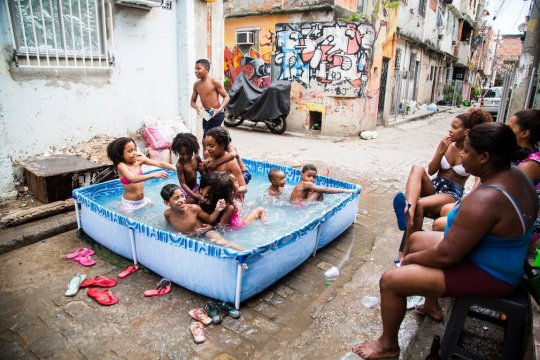
08| All of which is abstract until you stand in one place. Mathare is one of Nairobi's largest informal settlements. It is twenty minutes from the headquarters of the only UN agency in the world with an urban mandate. It has World Bank lending, multiple bilateral donors, a dozen or more INGOs, the national housing department, Nairobi City County, and a dense local ecosystem including Muungano wa Wanavijiji, Akiba Mashinani Trust and Slum Dwellers International. It has been the subject of a multi-year collaboration between Muungano, SDI, the University of Nairobi and UC Berkeley running since 2008. It is among the most studied informal settlements on earth.
09| Nobody can say how many people live there.
10| The published figures do not converge and are not close. Mathare as a collection of settlements is commonly given as approximately 500,000. Mathare Valley alone is given as 180,000. The Zonal Plan describes itself as aiming to improve conditions for over 200,000 residents. Another account of the same valley describes thirteen villages with an estimated population of 102,000. That is a factor of five between the highest and lowest figures for overlapping ground. The national census reports at administrative boundaries that do not match the lived boundary of the settlement, so it cannot arbitrate.
11| This is not a footnote and it is not a technicality. Every per-capita figure, every coverage claim, every cost-per-beneficiary calculation and every statement about what share of the settlement a project reached rests on a denominator that does not exist. A sector that cannot state its denominator cannot be audited, including by itself.
12| The organisation doing most to fix it is not an establishment actor. Muungano wa Wanavijiji runs community enumeration, and states the purpose in a sentence that describes precisely what the funded institutions lack:
"Enumeration aims to create a widely shared understanding of the settlement and the issues it faces, providing an alternative to political or market forces as the basis for community plans and development."— Muungano wa Wanavijiji
13| In May 2021 they mapped and numbered Mathare Kiamutisya village — roughly thirteen acres — to build a community physical address register. Thirteen acres at a time, by residents, because the alternative was not counting.
14| Set this against what the crisis half takes for granted and the absences are specific. No country team. No single needs assessment. No joint plan with a costed target. No pooled fund conditioning money on alignment. No Sphere-equivalent minimum anyone could measure a drainage investment against. No IPC-equivalent classification that turns a threshold into money.
15| The honest reading is that the crisis architecture was built by repeated public failure at speed, and chronic urban poverty has never produced the televised event that forces one into existence. Which raises a question worth holding open rather than answering: the same coordination machinery is one of the reasons crisis operations never end. Importing it may import the permanence with it.